
When Creativity Is Treated as a Break, Not a Discipline
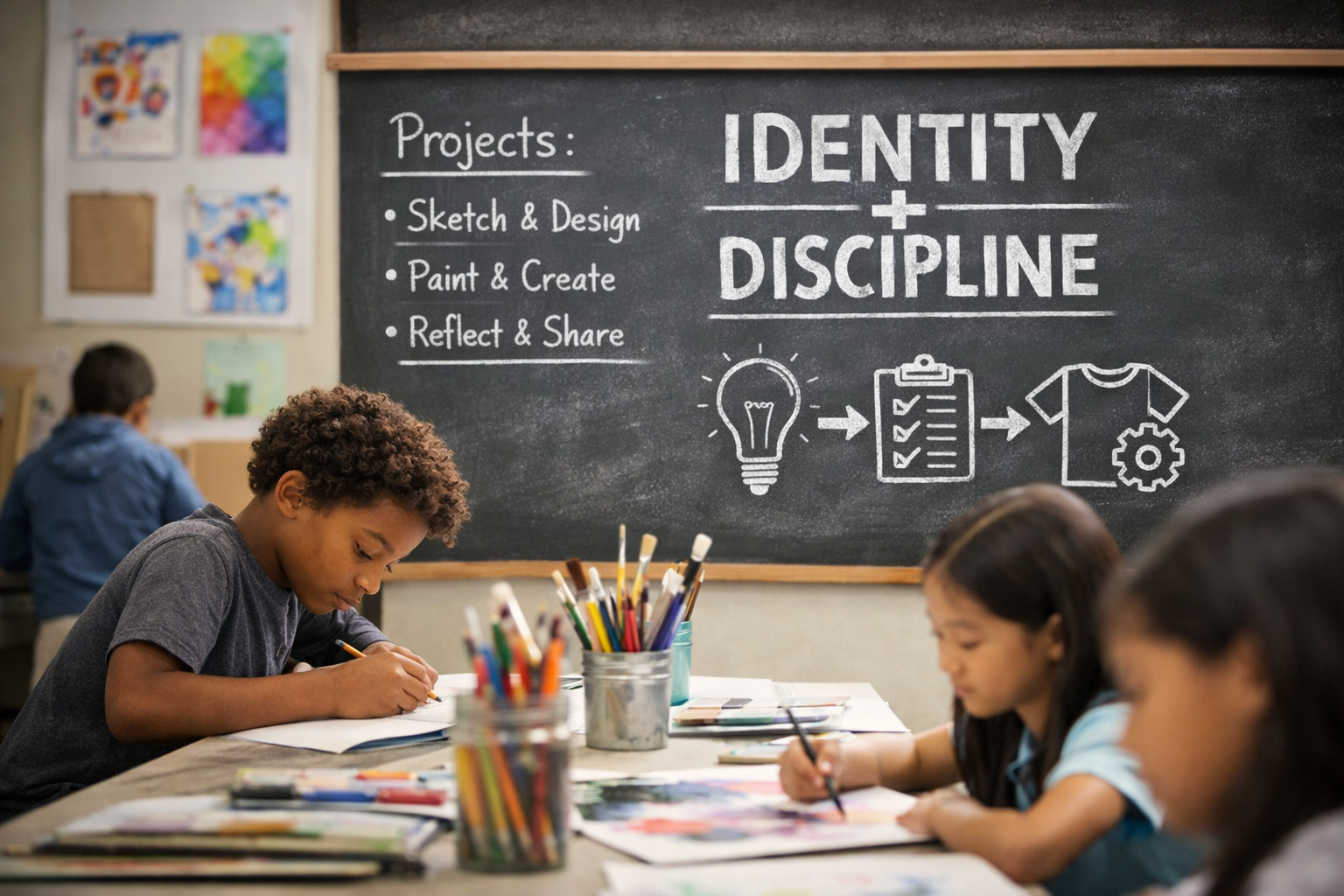
Across after-school programs, art schools, public libraries, community workshops, and short-term residencies, I’ve taught creative practice in many forms. These environments differ in structure and resources, but the pattern is consistent: creativity is rarely treated as a core learning tool.
In most enrichment settings, creative programming is positioned as a reward, a break from academics, or a way to occupy students after the school day ends. It is framed as extracurricular rather than instructional—something separate from learning instead of a method for it.
As a result, creative programs are often under-designed and underutilized. This is not due to lack of care, but to a misunderstanding of what disciplined creative practice actually develops.
The Cost of Treating Creativity as an Add-On
When creativity lacks structure, the outcomes are predictable.
In after-school programs I’ve worked in, creative classes were sometimes poorly communicated to students and families. Programs were assigned rather than chosen. Expectations were unclear. In those conditions, engagement dropped quickly.
Students disengaged or produced minimal work. Tools and spaces went unused. Behaviors were labeled as disinterest or lack of ability, when the issue was program design—not student capacity.
I observed the same pattern across visual art, media workshops, and public-facing community programs. When creativity was treated as something to fill time rather than something to practice, participation became surface-level and performative.
At the same time, students labeled as disruptive or unmotivated often demonstrated strong creative instincts. What they lacked was not interest, but a structure that could hold their attention and effort.
Identity and Discipline Are Not Opposites
The shift occurs when creativity is treated as a discipline rather than an escape.
In my teaching, identity means authorship—students recognizing themselves in what they create. This includes voice, cultural reference, personal meaning, and ownership of ideas. It does not mean unstructured freedom.
Discipline, in this context, is not control or punishment. It is repetition, technique, physical engagement, clear constraints, and guided practice. It is the presence of form.
When identity and discipline are combined, students don’t disengage—they settle. Focus increases. Risk-taking becomes possible because the structure provides safety.
I’ve seen students arrive dysregulated and calm themselves once clear processes were introduced. Students placed in creative classes as a form of behavioral management were able to regulate through drawing, movement, and repetition. Calm emerged not through correction, but through practice.
A Typical Example
During a summer program at a community youth center, enrollment was low and initial interest was minimal. When the workshop began, many students arrived disengaged.
Rather than pushing participation, I demonstrated the process.
The project focused on wearable art. Students could design a T-shirt or bandana using stencils, paint, and iron-on text. Once students saw what was possible, participation shifted quickly. Engagement became voluntary, then sustained. Nearly every student—and several staff members—joined in.
Nothing about the students changed.
The structure did.
Clear demonstration, defined constraints, and visible outcomes transformed the experience from something students endured into something they owned.
What Changed When the Design Was Right
Once structure was clarified:
Focus improved
Projects were completed
Materials were respected
Pride emerged naturally
For adults, redirection decreased. Chaos subsided. The space functioned as intended.
The same principles applied in martial arts instruction with younger students. Through structured movement, breath control, and repetition, students developed coordination, calm, and confidence. Regulation followed discipline—not the other way around.
The Role Creativity Is Meant to Play
Creativity in schools is not a break from learning.
It is a method of learning.
When treated as a disciplined practice rooted in identity, creativity supports focus, persistence, self-regulation, and meaning-making across subject areas. It develops skills that academic instruction alone often struggles to reach.
The risk schools face is not that students won’t become artists.
The risk is that they overlook one of the most effective tools available for engagement, development, and instructional alignment.
Noble Dre Ali
Teaching Artist & Program Designer
Noble Alkhemy
“I design and facilitate enrichment and residency-based creative programs across after-school, school-based, and community learning environments.”